Key Takeaways
- Authentic Italian interior design is built on three pillars: premium natural materials, disciplined form and function, and a mastery of light and negative space.
- The only reliable way to verify genuine craftsmanship is the “100% Made in Italy” certification, which protects against imported knockoffs sold under Italian-sounding names.
- Modern and classic Italian furniture can be blended into a single “transitional” room, and trade professionals can source both styles from one showroom.
For decades, the American idea of Italian interior design was stuck on one look: the “Tuscan farmhouse” aesthetic of faux-distressed terracotta, heavy wrought iron, and saturated, sun-baked colors. That regional style has its place, but it’s only a sliver of what Italian design actually means. Genuine Italian interior design is a standard of craftsmanship, not a color palette. It’s built on centuries of artisan skill, architectural discipline, and an almost stubborn dedication to material quality.
For interior designers, architects, and homeowners furnishing a serious project, understanding this distinction changes everything about how you shop. It’s the difference between a room that looks Italian-inspired and one that’s actually built to the standard the term implies. This guide breaks down what Italian interior design really is, how it evolved, the elements that define it, and how to source it without settling for a knockoff.
This isn’t theoretical for us. Michelangelo Designs has spent nearly four decades working directly with Italian manufacturing houses, sourcing everything from hand-carved traditional case goods to architectural modern collections for designers across the country. The standards outlined here reflect what actually separates genuine craftsmanship from marketing language, not just industry talking points.
What Is Italian Interior Design?
Italian interior design is a design philosophy built on premium natural materials, restrained form and function, and deliberate use of light and space, rooted in centuries of Italian craftsmanship rather than any single decorating trend.
It isn’t defined by a color scheme or a regional theme. It’s defined by how a piece is made. A genuine Italian dining table and a “Tuscan-style” table from a big-box retailer might occupy the same room in a catalog, but only one of them reflects the manufacturing standard, materials, and design lineage the term is meant to describe. That standard spans everything from the sleek, minimalist furniture coming out of Milan today to the ornate, hand-carved case goods rooted in Renaissance craftsmanship.
Understanding Italian interior design starts with knowing where it came from, because the throughline from a 17th-century workshop to a 21st-century showroom floor is craftsmanship, not aesthetics.
How Did Italian Interior Design Evolve?
Italian interior design evolved from the ornate, hand-carved opulence of the Renaissance and Baroque periods into the restrained, architectural minimalism of mid-century Milanese design, with artisan craftsmanship as the constant thread connecting both eras.
That evolution didn’t happen in a straight line, and knowing the two poles of it, where the style came from and where it landed, makes it much easier to shop for the right pieces today.
The Renaissance and Baroque Foundation
During the Renaissance and Baroque periods, Italian interiors were an exercise in visible wealth. Noble families commissioned artisans to build structurally complex, heavily ornamented furniture: intricate wood marquetry, gilded finishes, hand-carved frames, and heavy brocade upholstery. These weren’t decorative flourishes for their own sake. They were a demonstration of a family’s access to the best craftsmen in Europe.
This era is what established Italy as the epicenter of furniture making. The reputation wasn’t built on volume or availability. It was built on mastery of raw materials, including wood, stone, metal, and textiles, at a level few other regions could match.
The Mid-Century Shift
By the mid-twentieth century, a new generation of Italian designers began stripping away that ornamentation. Post-war Milanese designers focused on sleek lines, ergonomic function, and manufacturing techniques that hadn’t existed a generation earlier. This is the movement that produced the ultra-chic, architectural style most people now associate with “modern Italian design.”
What’s easy to miss is that the underlying discipline never changed. The techniques used to tan a full-grain leather, cast a metal base, or carve a solid wood frame were simply redirected toward a new aesthetic of restraint. A hand-carved walnut credenza from three hundred years ago and a low-profile leather sectional built last year share the same DNA: obsessive attention to material and construction, regardless of how ornate or minimal the final silhouette looks.
Regional Styles Within Italian Design
Italian interior design isn’t produced in one place, and the regional differences still show up in furniture today. Much of the country’s traditional, hand-carved case goods and upholstery trace back to Brianza, the manufacturing hub north of Milan that’s been home to Italian cabinetmaking families for generations. It’s where a lot of the deeply carved frames and hand-finished detailing associated with classic Italian furniture are still produced.
Milan itself, by contrast, is the epicenter of the modern movement: the architectural, industrial-influenced design language that dominates international furniture fairs and defines what most people picture when they hear “Italian modern furniture.” Tuscany and the rustic regional style most Americans associate with “Italian design” sits apart from both of these. It’s a legitimate regional aesthetic, but it isn’t representative of the broader craftsmanship standard that spans the rest of the country’s manufacturing tradition.
Knowing this matters practically: a showroom or brand that only offers one of these regional traditions is only showing a fraction of what authentic Italian interior design covers. Working with a sourcing partner that maintains relationships across multiple regions, rather than a single manufacturer or region, is usually the fastest way to access the full range of styles a project actually needs.
What Are the Three Pillars of Italian Interior Design?
Authentic Italian interior design rests on three non-negotiable pillars: unrivaled materiality, a disciplined balance of form and function, and a deliberate mastery of light and negative space.
Every genuinely Italian piece of furniture, whether it’s a sprawling estate’s dining table or a single accent chair, will reflect all three. If a piece is missing one, it’s worth asking why.
Unrivaled Materiality
Italian design demands premium, natural materials, full stop. There’s no place for synthetic leathers, manufactured stone composites, or veneer-heavy particleboard in an authentic piece.
Instead, you’re looking at the tactile brilliance of heavily veined Carrara and Calacatta marble, the luminous quality of hand-blown Murano glass, and the rich, evolving patina of full-grain Italian leather. Solid hardwoods, including walnut, mahogany, and other exotic and domestic species, are celebrated for their natural grain, not hidden under heavy paint or laminate.
This is also where the difference between real and imitation Italian furniture becomes obvious the moment you touch it. A marble-look laminate top feels cold and uniform. Real Carrara marble has subtle temperature shifts, natural veining, and a weight you can feel the second you set something on it. The same is true of leather: full-grain Italian leather develops a patina over years of use, while bonded or faux leather cracks and peels within a few seasons.
Balance of Form and Function
Italian luxury rejects clutter by design. Every piece has to earn its place in a room through both visual impact and structural integrity. There’s no room for furniture that exists purely as decoration or purely as utility. Even the most ornate, traditional pieces were built with a specific spatial purpose in mind.
In modern Italian interior design, this shows up as clean, architectural lines, where the engineering underneath a chair or table is treated as being just as important as its silhouette. A well-built Italian dining chair, for example, should be structurally sound enough to last decades, not just photograph well. That same logic applies to storage: a credenza or wardrobe should offer real, usable capacity, not just a sculptural front panel with shallow, impractical interior space.
Mastery of Light and Space
High-end Italian interiors use negative space intentionally, letting statement pieces breathe instead of filling every square foot of a room. Rather than crowding a space, Italian designers treat monolithic furniture, such as a large console, a sculptural coffee table, or an oversized headboard, as functional art.
That spatial discipline is reinforced by how a room handles light. Expansive windows, strategically placed mirrors, and sculptural lighting fixtures work together to create an airy, sophisticated atmosphere rather than a dim, over-furnished one. A room with too much furniture and too little light rarely reads as “Italian” no matter what brand names are in it.
Traditional vs. Modern Italian Design: What’s the Difference?
Traditional Italian furniture draws from Baroque, Neoclassical, and French Provincial influences with gilded finishes and deeply carved wood, while modern Italian interior design favors clean geometric lines, neutral palettes, and a restrained mix of metal, wood, and leather.
Knowing the difference matters because most real-world projects don’t pick one lane entirely. They blend both, and blending well requires knowing exactly what each style brings to a room.
Classic Italian Furniture
Classic and traditional Italian furniture leans heavily on Baroque, Neoclassical, and French Provincial influences. Expect gilded gold and silver leaf finishes, heavy silk and velvet textiles, and deeply carved wood frames. These pieces are unapologetically grand, designed to command attention and communicate heritage, not blend into the background.
Modern Italian Furniture
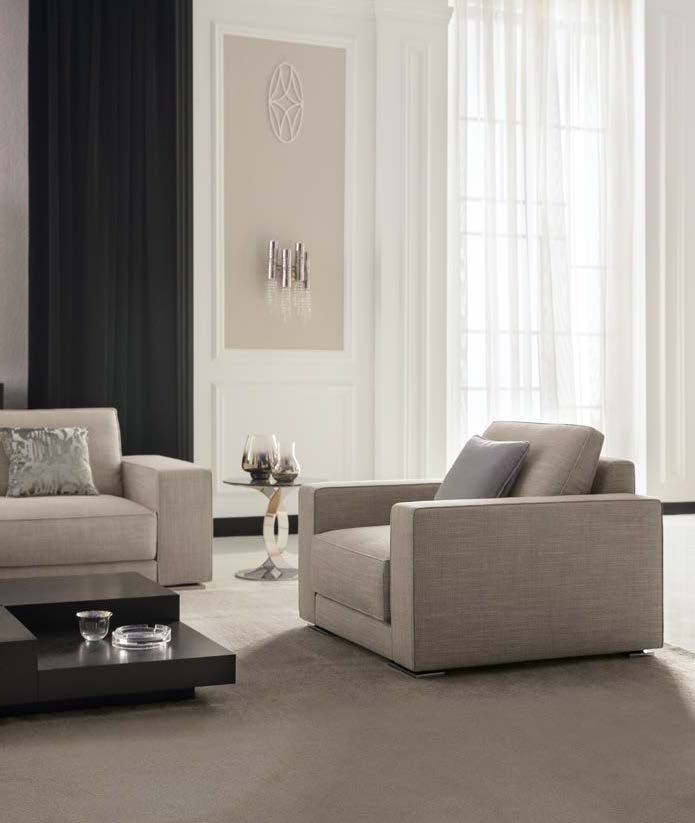
Modern Italian interior design, by contrast, is defined by restraint. The contemporary aesthetic favors clean, geometric lines and a monochromatic or neutral color palette. Expect low-profile sofas, floating vanities, and a deliberate mix of cold metals with warm, natural woods and leathers. This is the style most associated with Milan’s design houses, and it’s often what people picture first when they hear “Italian modern furniture.”
Blending the Two: Transitional Design
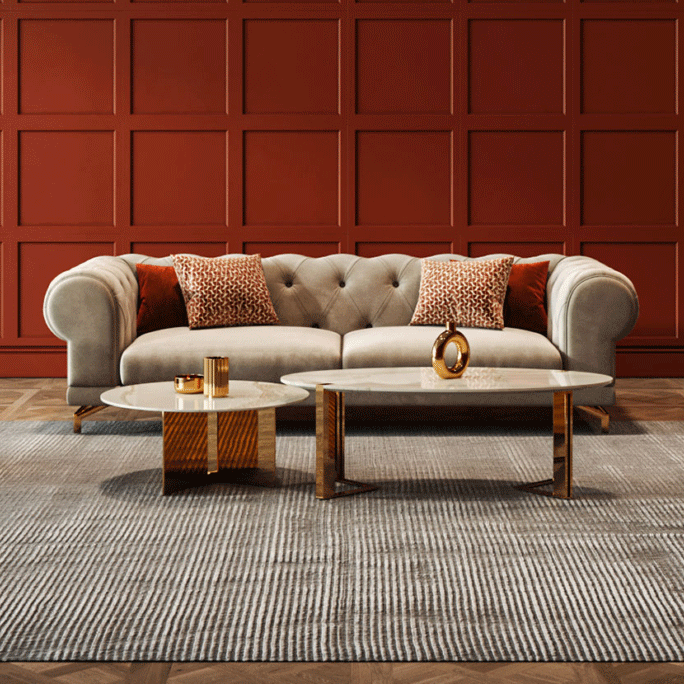
The most successful interior designers merge these two schools into what’s often called “transitional” luxury design. Pairing a sleek, minimalist stone coffee table with a room featuring classical architectural molding, or placing a highly ornate, gilded mirror above a low-slung, modern leather sofa, creates a dynamic tension. Done well, it reads as curated rather than mismatched, and it’s one of the most requested looks among designers sourcing high-end Italian furniture today.
How Do You Bring Italian Interior Design Into Each Room?
Translating Italian design philosophy into an American home requires a room-by-room strategy focused on scale, material contrast, and a single dominant focal point rather than an accumulation of smaller decorative pieces.
Below is how that philosophy plays out room by room, from the entryway to the home office. In every case, the same underlying rule applies: pick fewer, better pieces and let the room’s architecture and light do the rest of the work.
Entryway and Foyer
First impressions in Italian interior design are architectural, not decorative. A single, sculptural piece, often one of the Italian console tables found in most high-end collections, anchors the space, paired with a dramatic mirror or a piece of art rather than a cluster of smaller accessories. The goal is one confident statement, not a curated collection of trinkets.
Living Room
In the living area, the goal is to anchor the space with sculptural seating. Expansive, modular sectionals or luxury Italian sofas upholstered in premium leather or textured bouclé invite conversation while maintaining a low visual profile. These typically pair with minimalist stone coffee tables and a single, dramatic lighting fixture rather than multiple smaller lamps competing for attention.
Dining Room
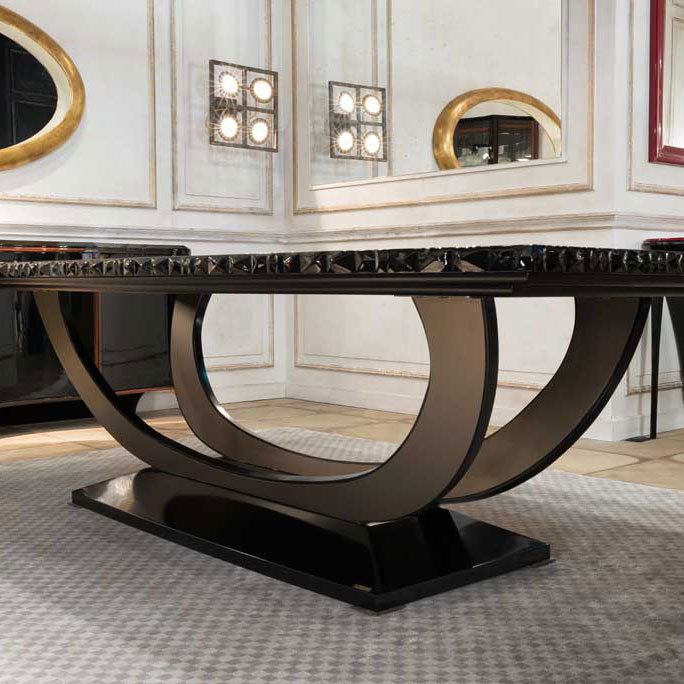
The dining space should evoke monumental permanence. Monolithic dining tables, featuring high-gloss wood finishes or thick slabs of marble, serve as the room’s center of gravity. These heavy tables are then contrasted with tactile, ergonomically designed dining chairs that prioritize comfort without sacrificing a sleek silhouette.
Bedroom
For the bedroom, Italian design emphasizes restful, sophisticated symmetry. Luxurious, oversized headboards, often extending horizontally past the nightstands, anchor the room, which is a hallmark of well-made Italian modern bedroom furniture. Bedding relies on imported, high-thread-count textiles, while surrounding case goods maintain clean lines and flawless veneer matching, so the space reads like a high-end boutique hotel rather than cluttered personal quarters.
Home Office
A serious home office needs furniture that performs under daily use without looking utilitarian. This is where Della Rovere office furniture and similar Italian-made desks, credenzas, and seating earn their keep. They’re built with the same material standards as the rest of the home, but engineered for long work sessions. Clean-lined executive desks and ergonomic seating in leather or performance textiles keep the room feeling considered rather than corporate.
Kitchen
Italian kitchen design applies the same materiality and restraint found throughout the rest of the home, favoring high-gloss lacquer, natural stone, and integrated hardware over the ornate, heavily trimmed cabinetry common in more traditional American kitchens.
Flat-front or slightly recessed cabinet doors, waterfall-edge stone islands, and hidden or minimal hardware keep the sightlines clean, while high-end Italian cabinet makers apply the same veneer-matching and finish standards used in their case goods to kitchen cabinetry. Even in a working kitchen, the goal is the same as everywhere else in an Italian-designed home: fewer, better-made elements instead of a busier collection of finishes and details.
Bar, Entertaining, and Specialty Spaces
For a home bar, media room, or dedicated entertaining space, Italian design leans into showpiece furniture. A well-crafted luxury bar cabinet, in high-gloss lacquer, exotic veneer, or a mix of glass and metal, becomes the room’s focal point rather than a purely functional storage piece. Kitchen and bar cabinetry from Italian manufacturers is built to the same construction standard as their case goods, which means it holds up under daily use far longer than typical big-box cabinetry.
Walls matter just as much as furniture in these spaces. Custom modern wood wall panels, known in Italian design as boiserie, add texture and architectural interest without adding clutter. It’s a technique borrowed directly from the paneled libraries and studies of classical Italian interiors, reinterpreted with cleaner, more contemporary lines.
What Are the Signature Italian Furniture Brands to Know?
The Italian furniture industry is built around family-run manufacturing houses, each specializing in a distinct construction technique, material, or aesthetic. Recognizing a handful of names makes it much easier to source the right piece for a specific room or style.
You don’t need to memorize dozens of manufacturers, but knowing a few by name, and what each is known for, gives you a real vocabulary for sourcing conversations with a designer or showroom.
- Mantellassi furniture is known for classic and transitional upholstery, with a construction technique built around traditional frame-making and hand-finished detailing.
- Orsenigo furniture specializes in refined case goods and bedroom collections, with a focus on veneer matching and finish quality.
- Bel Mondo furniture offers a broad range of transitional dining and living pieces designed to bridge classic and contemporary interiors.
- Carpanelli furniture is recognized for hand-carved traditional case goods as well as a contemporary line, making it a good example of how a single manufacturer can span both ends of the classic-to-modern spectrum.
- Della Rovere focuses on office and contract furniture engineered for daily commercial use without sacrificing the material standards found in residential collections.
Each of these houses has its own specialty, which is exactly why most serious Italian interior design projects end up sourcing from several manufacturers rather than a single catalog. A living room, a home office, and a primary bedroom rarely come from the same maker, and they shouldn’t.
Does Italian Interior Design Work for Commercial and Hospitality Spaces?
Italian interior design translates directly to hospitality and commercial projects because the manufacturing standard already builds for durability, and many Italian houses offer commercial-grade construction alongside their residential lines.
Hotels and restaurants put furniture through a level of daily wear that residential pieces are never designed for, which is exactly why commercial-grade construction matters so much in this segment. A boutique hotel lobby or a busy restaurant dining room needs seating and case goods that can handle constant turnover without looking worn down within a year, something fast furniture simply isn’t built to do.
This is also where sourcing efficiency becomes a real factor. Hospitality and commercial designers are typically managing several projects simultaneously, each with different style requirements and often larger, bulk order quantities. Working directly with Italian manufacturers, rather than through multiple disconnected vendors, makes it possible to get commercial-grade construction at a wholesale price point while still pulling from the same traditional-to-modern style range used on residential projects.
A hotel lobby might call for the same architectural, modern Italian furniture used in a Milanese apartment; a restaurant’s private dining room might call for the traditional, carved detailing more common in a formal residential dining space. Both are achievable from the same sourcing relationship.
What Should You Budget for Genuine Italian Furniture, and How Long Does It Take?
Genuine Italian furniture typically ships on an 8 to 12 week lead time from order to delivery, and pricing reflects the cost of solid materials and hand construction rather than mass production. This is why it should be budgeted as a long-term investment instead of a one-time furnishing expense.
Custom orders, such as a specific leather, a particular wood finish, or a made-to-measure sectional, tend to sit at the longer end of that window, while in-stock or lightly customized pieces move faster. Either way, that timeline needs to be part of project planning from the start. Trying to compress an 8- to 12-week manufacturing process into a two-week deadline is one of the most common ways a project ends up settling for a lower-quality substitute at the last minute.
On cost, it helps to reframe the comparison. A genuine Italian sofa or dining table will almost always cost more upfront than a comparable big-box piece. But fast furniture is built to a 5- to 10-year lifespan at best, while a well-made Italian piece is built to be used, sold, or handed down for decades. When the cost is measured per year of use rather than per unit at checkout, the math changes considerably, and that’s before accounting for the resale value genuine pieces tend to hold.
How Can You Tell If Furniture Is Authentically Made in Italy?
Authentic Italian furniture carries a certified “100% Made in Italy” designation, meaning the raw materials were sourced, processed, and the final piece was entirely assembled within Italy’s borders under EU manufacturing regulations.
As Italian luxury furniture has grown in popularity, the market has been flooded with imitations. Plenty of manufacturers use “Italian-sounding” brand names or lean on marketing phrases like “Italian design” or “Italian leather” for products that are mass-manufactured and assembled overseas, sometimes using imported materials but foreign labor and finishing.
Why “100% Made in Italy” Matters
For trade professionals and serious buyers, “100% Made in Italy” is the only acceptable standard, and it’s not just a marketing slogan. It’s a strict designation protected by European Union manufacturing regulations. For a piece to legitimately earn this certification, every step of the process, from sourcing and processing raw materials to final assembly and finishing, has to happen inside Italy.
That distinction is easy to miss on a showroom floor or a website listing. This is exactly why so many buyers end up with a piece that looks right in photos but doesn’t hold up structurally, aesthetically, or in resale value.
What to Ask Before You Buy
Before purchasing a piece marketed as Italian, it’s worth asking a few direct questions:
- Is the piece certified 100% Made in Italy, or only “Italian designed”?
- Where were the raw materials sourced, and where was final assembly completed?
- Can the seller provide documentation or manufacturer information to back up the claim?
- Does the warranty or return policy reflect confidence in long-term construction quality?
A reputable dealer should be able to answer all four without hesitation. If a seller gets vague about the country of assembly, that’s a signal worth taking seriously, and it’s worth asking to see manufacturer documentation directly rather than taking a product description at face value. Trade showrooms that work directly with Italian manufacturers can typically produce this paperwork on request; retailers reselling through several layers of distribution often can’t.
The Investment Case for Genuine Italian Furniture
Investing in 100% Made in Italy trade furniture guarantees a level of durability and quality control that fast-furniture factories simply can’t replicate. The lifecycle return on investment for a genuine Italian piece is measured in generations, not years. These pieces retain their structural integrity and often hold or appreciate in resale value, which makes them a real investment rather than a depreciating purchase. That distinction matters most on large-scale residential or hospitality projects where furniture budgets run into six or seven figures.
What Mistakes Should You Avoid When Sourcing Italian Furniture?
The most common mistakes when sourcing Italian interior design pieces are trusting marketing language over certification, mismatching scale between rooms, and buying from a single style category instead of blending traditional and modern pieces.
A few of these come up again and again on real projects, and they’re worth flagging before you start sourcing:
- Trusting the word “Italian” alone. As covered above, that word alone guarantees nothing. Always confirm the 100% Made in Italy certification directly.
- Underestimating scale. Italian design relies on monolithic, statement-making pieces. A dining table or sectional that’s too small for the room undercuts the entire aesthetic, no matter how well it’s made.
- Overfilling the room. Italian interiors rely on negative space. Adding “just one more” accent piece often does more harm than good.
- Sourcing everything from one style bucket. Rooms that mix a single traditional or single modern brand throughout tend to feel flat. The most successful interiors blend manufacturers and eras intentionally.
- Skipping lead-time planning. Genuine Italian manufacturing isn’t instant. Builds typically run 8 to 12 weeks depending on the piece and customization, so timelines need to be part of the sourcing conversation from day one, not an afterthought once a project is already behind schedule.
- Using residential vendors for commercial projects. Hospitality and contract work needs commercial-grade construction, not a residential piece that happens to look sturdy. Confirm the manufacturer actually rates the piece for commercial use before specifying it for a hotel, restaurant, or office project.
Source Authentic Italian Masterpieces for Your Next Project
Finding genuine Italian craftsmanship stateside requires partnering with a sourcing expert who understands the nuances of the trade. Since 1985, Michelangelo Designs has served as the premier destination for interior designers, architects, and discerning homeowners seeking authentic Italian luxury.
Operating out of a 40,000-plus square foot trade showroom in Passaic, New Jersey, Michelangelo Designs bridges the gap between Italy’s most prestigious manufacturing houses and the American design market. Whether a project calls for the opulent carving of a classical heritage brand or the sleek, architectural lines of contemporary Milanese design, it’s all sourceable under one roof. The direct manufacturer relationships keep lead times to a predictable 8 to 12 weeks.
Stop settling for imitations and elevate a design portfolio with furniture that meets the highest global standards of craftsmanship. Register for a Michelangelo Designs trade account to unlock exclusive pricing and gain unparalleled access to 100% Made in Italy collections, or book an appointment at the New Jersey showroom to experience the tactile brilliance of authentic Italian interior design firsthand.
Ready to Source Authentic Italian Furniture?
Get direct access to 100% Made in Italy collections, trade-only pricing, and a showroom built for serious design projects. Register for a Trade Account.